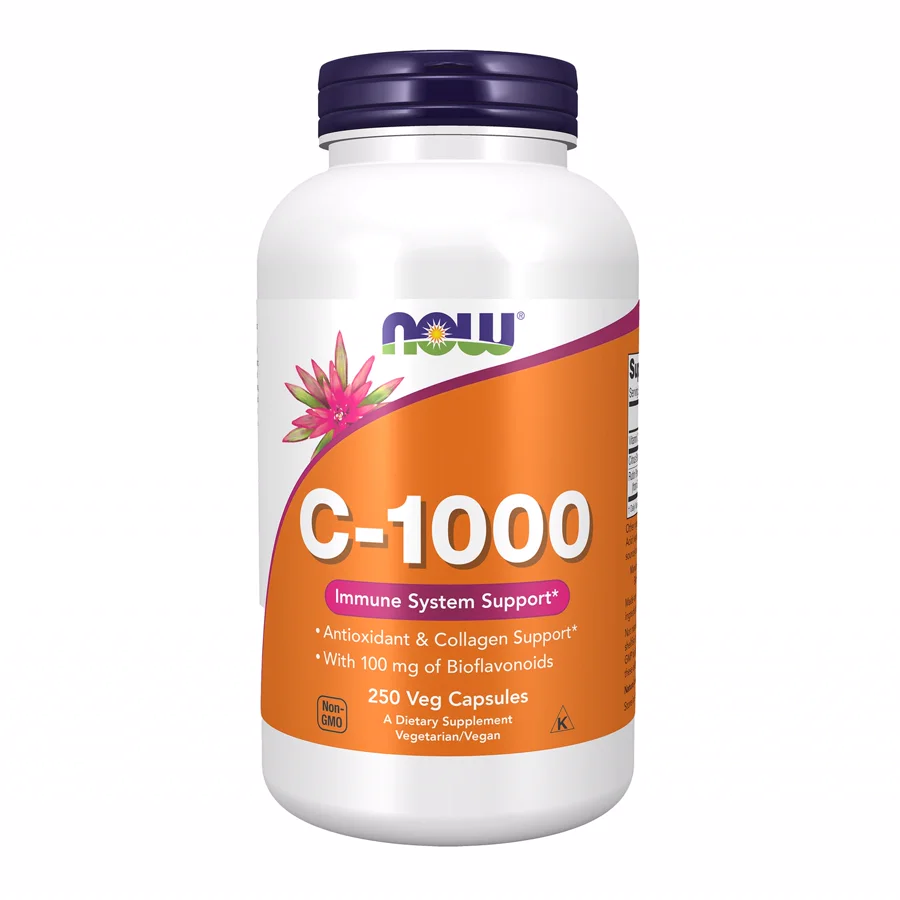
NOW Foods Vitamin C-1000
A plain, single-ingredient vitamin C capsule from one of the industry's oldest independently-audited manufacturers. We checked the actual label math against NIH's own reference intakes, verified exactly which certifications NOW Foods really holds, and read the real clinical research on vitamin C and the common cold — including where that research is more modest than the marketing around this vitamin usually suggests.
What It Actually Is
NOW Foods sells more than one product under the "C-1000" name, and it's worth being precise about which one this is. This review covers the standard NOW Foods Vitamin C-1000 with 100 mg Bioflavonoids veg capsule (sold in 100- and 250-count bottles) — not NOW's separate sustained-release tablet version, and not its separate rose-hips version, both of which carry different release mechanisms or added ingredients under a similar name. If you're comparing listings, check the label on the specific bottle you're looking at rather than assuming every "NOW C-1000" is identical.
The formula itself is simple: one active ingredient (ascorbic acid) plus a citrus bioflavonoid complex and rutin, in a vegetarian capsule shell. No proprietary blend, no undisclosed "complex" hiding the actual dose — the label states a specific milligram amount for every ingredient, which is not something we can say about most of the products we report on.
Real Ingredient & Dose Facts
Per the label (one veg capsule, the stated serving size):
- Vitamin C (as ascorbic acid): 1,000 mg (1,111% DV)
- Citrus Bioflavonoid Complex: 100 mg
- Rutin (from Sophora japonica flower bud): 25 mg
- Other ingredients: hypromellose (vegetarian capsule), stearic acid, magnesium stearate (vegetable-sourced), silicon dioxide
Directions on the label: one capsule daily, or as directed by a healthcare practitioner.
Here's how that stacks up against the government's own numbers. The National Institutes of Health's Office of Dietary Supplements (NIH ODS) sets the Recommended Dietary Allowance (RDA) for vitamin C at 90 mg/day for adult men and 75 mg/day for adult women (smokers are advised to add 35 mg/day on top of that, since smoking increases vitamin C turnover). One capsule of this product delivers roughly 11 to 13 times the RDA — a genuinely high dose relative to what's nutritionally required, though not an unusual one in this supplement category.
NIH ODS also sets a Tolerable Upper Intake Level (UL) for adults of 2,000 mg/day, based on the risk of osmotic diarrhea and gastrointestinal upset at higher intakes rather than any organ toxicity. At 1,000 mg, one capsule of this product uses up exactly half that daily ceiling — comfortably inside the range NIH considers studied and safe for a healthy adult, but worth knowing if you're also getting vitamin C from a multivitamin, fortified foods, or a second supplement, since those can add up toward the UL faster than people expect.
Real Certification Precision — Read This Part Carefully
This is the part where supplement labels get misread the most, so we're going to be exact about it.
NOW Foods' Bloomingdale, Illinois manufacturing facility was GMP-certified by the Natural Products Association (NPA) in 2000 — one of the first facilities in the industry to earn that certification. Its second U.S. facility, in Sparks, Nevada, has gone through the same program. In 2016, Underwriters Laboratories (UL) — later named the NPA's official third-party auditor for that GMP program — became one of the first bodies to independently audit and certify NOW's dietary-supplement manufacturing process at both facilities. NOW is also certified by Eurofins Healthcare Assurance to NSF/ANSI 455-2, the specific GMP standard written for dietary supplement manufacturing.
That's a real, independently-audited manufacturing track record, and it's genuinely more than most of the products we cover on this site can show.
Here's the caveat worth flagging: all of that is facility-level manufacturing certification — it confirms NOW's plants are independently audited for how products are made (sanitation, ingredient testing, batch records, that kind of thing). It is not the same thing as a product-specific third-party seal printed on this particular bottle, like NSF Certified for Sport, Informed Choice/Informed Sport, or USP Verified. Those seals mean a specific finished product was tested batch-by-batch for banned substances or label-claim accuracy. NOW does use some of those product-level seals — but on its separate "NOW Sports" line, aimed at competitive athletes, not on the standard NOW Foods Vitamin C-1000 covered here. If a product-tested seal on the bottle itself matters to you, that's a real, meaningful difference — not a technicality.
Real Research: Vitamin C and the Common Cold
Vitamin C's reputation as a cold remedy is one of the most-marketed and most-oversold claims in the supplement aisle, so we went to the actual clinical trial data rather than the marketing copy.
The most-cited body of evidence here is a Cochrane systematic review led by Harri Hemilä, pooling dozens of randomized trials. The honest summary of what it found:
- Taken regularly, before getting sick (the "prophylactic" trials): vitamin C shortened cold duration by about 8% in adults and about 14% in children, across the pooled trial data.
- Started only after symptoms already began (the "therapeutic" trials, which is how most people actually reach for vitamin C): the pooled trials showed no significant difference from placebo.
- Preventing a cold from happening at all, in the general population: the effect was small and not statistically significant (pooled relative risk 0.96) — regular vitamin C did not meaningfully cut how often ordinary adults caught a cold.
- One real exception: in a smaller subgroup of trials on people under brief, extreme physical stress — marathon runners, skiers, and soldiers on sub-arctic exercises — regular vitamin C cut cold incidence roughly in half (relative risk 0.50). That's a specific, well-documented finding in a narrow population, not something that generalizes to normal daily life.
Our honest read: this is not a product that prevents or cures colds, and we're not going to frame it that way. The real, replicated effect is a modest shortening of cold duration when vitamin C is already in your system before you get sick — most useful if you take it consistently, not as a reach-for-it-once-you're-sneezing remedy, and most pronounced in situations of real physical stress rather than typical office-and-errands life.
Who This Is — and Isn't — For
Reasonable fit: someone who wants a plain, high-potency, single-ingredient vitamin C supplement from a manufacturer with a real, independently-audited manufacturing history, and who plans to take it consistently rather than only when they feel a cold coming on. The large 250-count bottle also makes it a reasonably economical daily option compared to buying single-serving packets.
Worth a second look, or a doctor's input, if: you already get meaningful vitamin C from a multivitamin, fortified foods, or another supplement — stacking multiple sources on top of a 1,000 mg capsule can approach the 2,000 mg adult UL faster than people expect. There's also a specific, documented finding worth knowing: a large cohort study of Swedish men published in JAMA Internal Medicine found men taking 1,000 mg/day or more of supplemental vitamin C had roughly double the risk of kidney stones compared to men taking none — a real, dose-specific data point (not a reason to panic, but a real reason for anyone with a personal or family history of kidney stones to talk to a doctor before taking a full 1,000 mg capsule daily).
Not the right pick if: you're looking for a seal-tested-for-sport product (see the certification section above — that's NOW's separate Sports line, not this one), or if you're buying this expecting it to prevent or cure a cold outright — the real evidence doesn't support that framing, however common it is in vitamin C marketing generally.
Where to Buy It
We couldn't reliably confirm a single stable product-page URL still matches the current listing at the moment we checked (Amazon listings and pack sizes shift), so we're linking to a live, specific Amazon search for this exact product rather than guessing at a URL that might redirect or go stale — it takes you straight to the current listings for this product.
See NOW Foods Vitamin C-1000 on AmazonSources
- NIH Office of Dietary Supplements, Vitamin C — Health Professional Fact Sheet (RDA, Tolerable Upper Intake Level, kidney stone risk discussion)
- Hemilä H, Chalker E. Vitamin C for preventing and treating the common cold. Cochrane Database of Systematic Reviews.
- Thomas LD, et al. Ascorbic Acid Supplements and Kidney Stone Incidence Among Men. JAMA Internal Medicine.
- Natural Products Association (NPA) GMP certification program records; Underwriters Laboratories (UL) dietary supplement GMP certification records — both as reported in industry trade press (Nutritional Outlook, SupplySide SJ)
- NOW Foods, company history and facility information (nowfoods.com, NOW Health Group)
- Product label data: NOW Foods Vitamin C-1000 with 100 mg Bioflavonoids, veg capsules (manufacturer listing and retailer product pages)
Talk to a healthcare provider before starting any new supplement, especially if you have a history of kidney stones or take other vitamin C-containing products.
These statements have not been evaluated by the FDA. This product is not intended to diagnose, treat, cure, or prevent any disease.
American Wellness Daily is a participant in the Amazon Services LLC Associates Program, an affiliate advertising program designed to provide a means for sites to earn advertising fees by advertising and linking to Amazon.com. As an Amazon Associate, American Wellness Daily earns from qualifying purchases.