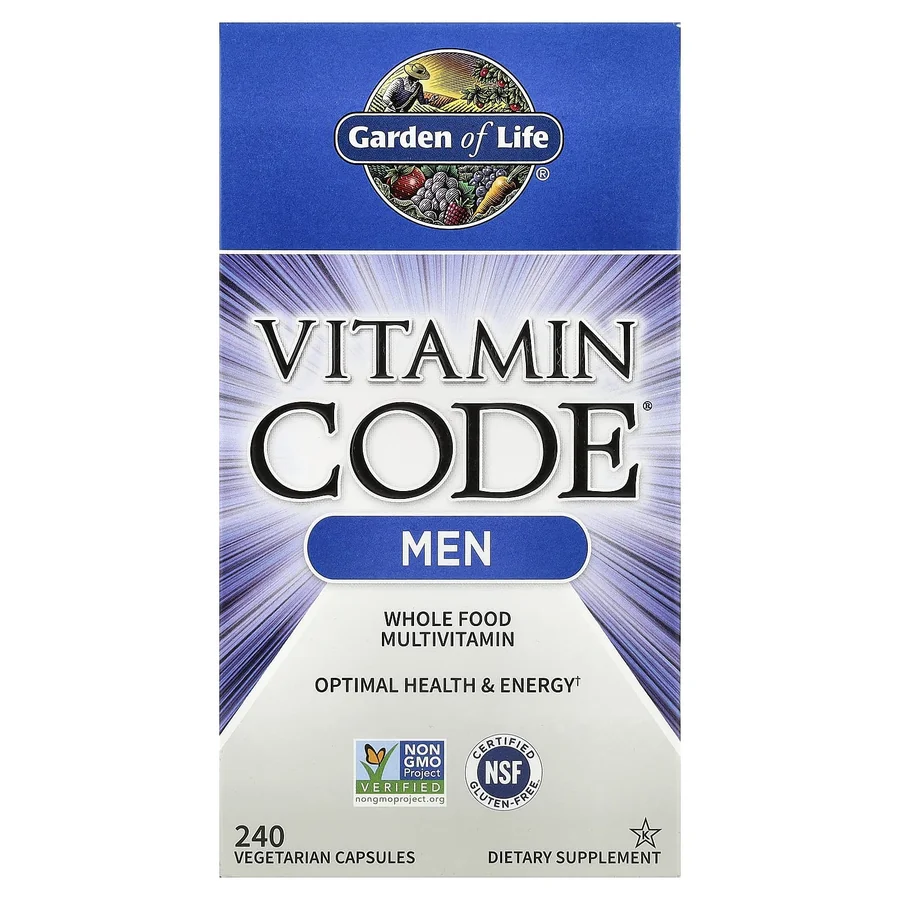
Garden of Life Vitamin Code Men
This whole-food multivitamin really does carry two independently-verified seals — Non-GMO Project Verified and NSF Certified Gluten-Free. It does not carry a Certified Vegan seal, whatever a stray review blog says. Here's the label, checked line by line against NIH reference values.
What It Actually Is
Vitamin Code Men is Garden of Life's flagship men's multivitamin — a 4-capsule daily serving built around 23 powdered organic fruits and vegetables plus a "RAW" probiotic and digestive-enzyme blend, sold in 120- and 240-capsule bottles. It's a different product from the brand's once-daily "RAW One for Men" line, which uses smaller single-capsule doses — worth knowing before you compare labels, since the two are easy to confuse under the same "Vitamin Code" name.
Garden of Life is a real, established manufacturer, not an anonymous funnel brand. It's been part of Nestlé Health Science since Nestlé's 2018 acquisition of Atrium Innovations, the Canadian nutrition group that owned it. The 240-capsule bottle we checked sells on Amazon for $60.89 (about $0.25/capsule), currently in stock, rated 4.6 out of 5 stars from 9,323 ratings on the listing at the time of writing — prices and review counts on Amazon change, so treat those two figures as a snapshot, not a promise.
The Certifications, Precisely
The product's own Amazon listing states its certifications in one line: "Non-GMO Project Verified, NSF Certified Gluten-Free, Kosher, RAW." Each of those means something different, and it's worth being exact about which is which.
Non-GMO Project Verified is a real third-party certification — not a company's own "non-GMO" label claim. The Non-GMO Project is an independent nonprofit that verifies ingredients through supply-chain traceability and testing before it allows a product to carry its butterfly seal. That's a meaningfully stronger claim than an unverified "non-GMO" line printed by the manufacturer itself, and this product's listing does specifically claim the third-party-verified version.
NSF Certified Gluten-Free is also real, but it's narrower than it sounds. NSF International runs a dedicated Gluten-Free Certification Program, built around independent lab testing (products must come in under 20 ppm gluten) plus a facility audit and formulation review. That's a genuine, checkable certification — but it certifies gluten content specifically, not the overall accuracy of every other claim on the label. Garden of Life's other product line, mykind Organics, separately holds NSF's broader "Certified for Content and Label Claims" certification (identity, potency, and purity testing against the entire label) — Vitamin Code Men does not carry that specific, more comprehensive NSF certification. Both are real NSF programs; they are not the same program, and a shopper skimming "NSF Certified" on two different Garden of Life bottles could reasonably assume they're getting the same guarantee when they aren't.
Kosher certification is listed on multiple retailer product pages for this item, though the specific certifying agency isn't stated on the primary Amazon listing itself, so we're not able to name it precisely here.
"RAW" is Garden of Life's own manufacturing claim — the company states its raw-format products are processed below 115°F without high-heat binders, fillers, or synthetic sweeteners. That's a real formulation choice worth knowing about, but it's a company claim, not an independent third-party certification like the two above it.
Not Certified Vegan. This is the one place we'd correct the record: at least one review site describes Garden of Life's Vitamin Code line generally as "vegan certified." For this specific product, that's not accurate. Amazon's own product-detail field for Vitamin Code Men lists "Diet Type: Vegetarian" — not vegan — and the manufacturer's feature-bullet copy doesn't claim a vegan certification anywhere. Other single-nutrient products in the same Vitamin Code family, like RAW Vitamin C and RAW Iron, do carry a genuine Certified Vegan seal, which is likely where the confusion comes from. If a strict vegan diet matters to you, don't assume it carries over to the multivitamin.
The Doses, Checked Against NIH Reference Values
We compared the label's per-serving amounts (4 capsules) against the National Institutes of Health Office of Dietary Supplements' Recommended Dietary Allowances (RDAs) and Tolerable Upper Intake Levels (ULs) for adults. Most nutrients land almost exactly at 100% of the current FDA Daily Value, which itself tracks the adult RDA closely for most of these nutrients:
- Vitamin A — 1,080 mcg RAE (120% DV), from beta-carotene. Sourced as provitamin-A beta-carotene rather than preformed retinol, which matters: NIH's UL for vitamin A (3,000 mcg/day) applies to preformed retinol, not to beta-carotene, so this form carries essentially no vitamin A toxicity risk even above 100% DV.
- Vitamin D3 — 20 mcg / 800 IU (100% DV). That's above the adult RDA of 15 mcg (600 IU) but well under the 100 mcg (4,000 IU) UL — a reasonable, safe dose.
- Vitamin B12 — 40.1 mcg (1,670% DV). This looks alarming next to the 2.4 mcg adult RDA, but NIH has not set a UL for B12 — the body absorbs it inefficiently and excretes what it doesn't use, which is the standard industry reason multivitamins overdose it this heavily.
- Folate — 400 mcg DFE (100% DV), sourced from a food-culture fermentation (S. cerevisiae) rather than synthetic folic acid. That distinction matters because NIH's folate caution about masking a B12 deficiency at high intakes is specifically about synthetic folic acid, not food folate.
- Zinc (11 mg), Selenium (55 mcg), Manganese (2.3 mg), Chromium (35 mcg), Molybdenum (45 mcg) — each lands at 100% DV, matching the adult RDA/AI almost exactly rather than over- or under-shooting it.
- Iodine — 75 mcg (50% DV). This is the one nutrient on the label that's genuinely underdosed relative to the 150 mcg adult RDA — the multivitamin supplies only half of what an adult needs in a day. If you don't otherwise eat iodized salt, dairy, or seafood, this product alone won't fully cover your iodine requirement.
None of the amounts we checked exceed an NIH-established Tolerable Upper Intake Level, and the label's stated allergen note is worth repeating honestly: the product doesn't list dairy, soy, peanut, tree nut, or shellfish ingredients, but it's manufactured in a facility that also processes those allergens.
What the Research Actually Shows — and Doesn't
The strongest recent evidence for daily multivitamin use comes from COSMOS, a large NIH-funded randomized trial of adults 60 and older, whose cognition sub-study (published in the American Journal of Clinical Nutrition, 2023) found a daily multivitamin-mineral supplement slowed global cognitive aging by roughly the equivalent of two years compared with placebo over three years. That's real, peer-reviewed, randomized evidence — but it's honest to disclose that COSMOS tested a standard synthetic multivitamin (Centrum Silver), not Garden of Life's whole-food, fermented-delivery formula. It supports the general category of "take a daily multivitamin," not a specific claim that raw or whole-food sourcing outperforms a synthetic one — we found no published clinical trial testing Vitamin Code's own formula or delivery method head-to-head against a standard multivitamin.
On the other side, it's worth knowing that the largest long-term multivitamin trial in men, the Physicians' Health Study II (JAMA, 2012), found no reduction in cardiovascular events from a daily multivitamin, and the U.S. Preventive Services Task Force's 2022 recommendation statement concluded the current evidence is insufficient to say whether multivitamin supplementation prevents cardiovascular disease or cancer in the general population — and specifically recommends against beta-carotene or vitamin E supplementation for that purpose (a caution about isolated high-dose supplements, not about eating those nutrients through food or a modest whole-food multivitamin like this one).
Put plainly: a multivitamin like this one is reasonable insurance against small dietary gaps, and the cognitive-aging signal from COSMOS is genuinely encouraging for older adults — but neither NIH nor USPSTF evidence supports marketing any multivitamin, whole-food or synthetic, as disease prevention.
Who This Is (and Isn't) For
A reasonable fit for men who want broad-spectrum nutritional insurance, prefer food-cultured nutrient forms and organic produce blends over isolated synthetic vitamins, and don't mind swallowing four capsules a day. It's a poor fit for anyone needing therapeutic, single-nutrient doses (a confirmed vitamin D or iron deficiency needs a targeted supplement, not a multivitamin), anyone who needs a fully iodine-complete multivitamin without also eating iodized salt or seafood, and anyone who specifically needs a Certified Vegan product rather than a vegetarian one.
Where to Buy It
We reviewed the 240-capsule bottle of Garden of Life Vitamin Code Men, currently listed on Amazon at $60.89 with 4.6/5 stars across 9,323 ratings. This is the actual product we researched above, not a substitute.
See Garden of Life Vitamin Code Men on AmazonTalk to a healthcare provider before starting any new supplement, especially if you take medication, are pregnant or nursing, or have a thyroid condition (relevant given the iodine content noted above).
These statements have not been evaluated by the FDA. This product is not intended to diagnose, treat, cure, or prevent any disease.
As an Amazon Associate, American Wellness Daily earns from qualifying purchases.
Sources
- Amazon.com, product listing and "Diet Type: Vegetarian" detail, Garden of Life Vitamin Code Mens Multivitamin, 240 Capsules — amazon.com
- NSF International, Quick Guide to NSF Gluten-Free Certification — nsf.org
- NSF International, Gluten-Free Food Certification program overview — nsf.org
- Non-GMO Project, verification standard — nongmoproject.org
- NIH Office of Dietary Supplements, fact sheets for Vitamin A, Vitamin D, Vitamin B12, Folate, Zinc, and Iodine (Health Professional editions) — ods.od.nih.gov
- Baker et al., "Effect of multivitamin-mineral supplementation versus placebo on cognitive function: results from the clinic subcohort of COSMOS," American Journal of Clinical Nutrition, 2023 — ajcn.nutrition.org
- Gaziano et al., "Multivitamins in the Prevention of Cancer in Men: The Physicians' Health Study II Randomized Controlled Trial," JAMA, 2012 — pubmed.ncbi.nlm.nih.gov
- US Preventive Services Task Force, "Vitamin, Mineral, and Multivitamin Supplementation to Prevent Cardiovascular Disease and Cancer," JAMA, 2022 — uspreventiveservicestaskforce.org
- Just Food, "Nestlé to buy Garden of Life owner Atrium Innovations" — just-food.com