Align Probiotic
Align's whole pitch rests on one thing: a single, specific bacterial strain with its name printed right on the label. We checked whether that name still means what it used to, whether the capsule's real dose matches what was actually tested, and exactly what that research does — and doesn't — cover.
What It Is
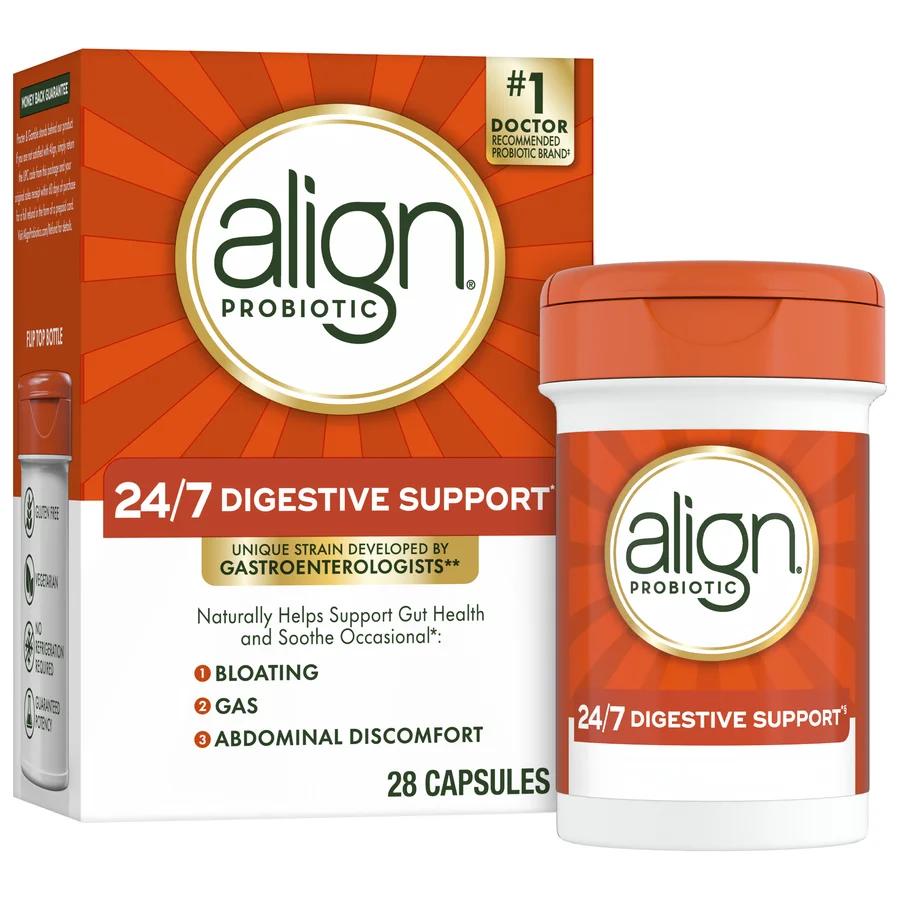
Align is Procter & Gamble's daily probiotic capsule line, sold in U.S. drugstores and on Amazon. The flagship product — sometimes labeled "24/7 Digestive Support" — is a single-strain capsule taken once a day, distinct from the crowded shelf of multi-strain, multi-billion-CFU "probiotic blends" it sits next to. P&G also sells an Extra Strength version at a higher dose, and other line extensions (a junior formula, a probiotic-plus-prebiotic version), but the ingredient we're evaluating here — and the one the brand's entire research history is built on — is the original single strain used in the standard capsule.
That's worth stating plainly up front, because it's the opposite of how most of the products we cover on this site are built: Align doesn't lean on a long proprietary blend of ingredients nobody can trace. It leans on exactly one, and stakes its credibility on that one strain's research record.
The Real Dose on the Label
According to the product's Supplement Facts panel (Procter & Gamble's own SmartLabel listing and the NIH's Dietary Supplement Label Database), one capsule of standard-strength Align is labeled as containing 1 x 10⁹ CFU (one billion live bacteria) of the strain at the time of manufacture, with a guaranteed minimum potency of 1 x 10⁷ CFU (ten million) through the printed best-by date. The Extra Strength version is labeled higher — 5 x 10⁹ CFU (five billion) at manufacture, with a guaranteed minimum of roughly 5 x 10⁷ CFU (fifty million) through the best-by date. Suggested use on both is one capsule daily, with or without food. Other ingredients listed are microcrystalline cellulose, hypromellose, sucrose, magnesium stearate, sodium caseinate, titanium dioxide (color), trisodium citrate dihydrate, propyl gallate, and gellan gum — a standard capsule-shell and stabilizer list, not a proprietary blend hiding anything.
That's a real, disclosed, checkable number — most of the products we review on this site don't even clear that bar. Whether it's the specific number shown to work in the clinical trials is a separate question, and we get into that honestly below.
Getting the Strain Name Right
This is the single most important fact to get precise, so we'll be exact about it. The organism was originally isolated and studied under the name Bifidobacterium infantis 35624 (also marketed for years under the trade name "Bifantis"). In 2016, whole-genome sequencing work reclassified it taxonomically, and it is now correctly identified as Bifidobacterium longum subspecies longum, strain 35624 — shortened on current Align packaging and marketing to "Bifidobacterium 35624™" or "Bifidobacterium longum 35624™."
The number — 35624 — is the part that actually matters, and it hasn't changed. It's a strain-deposit identifier, not a rebrand for marketing purposes; the organism is the same bacterium studied since the 1990s, just correctly renamed at the species level after better genetic testing became available. We're calling this out specifically because it's an easy thing for lazier coverage to get wrong in either direction — either still calling it "B. infantis" as if the science stood still, or, worse, treating "Bifidobacterium longum" alone as if it means anything. It doesn't. Bifidobacterium longum is an extremely common species name covering countless different strains sold across dozens of unrelated supplement brands, the overwhelming majority of which have no clinical research behind them at all. The research described below applies to strain 35624 specifically — not to "Bifidobacterium longum" as a category, and not to any other brand's Bifidobacterium longum product just because the species name matches.
What the Research Actually Shows
Strain 35624 has one of the more genuinely substantial research records of any single probiotic strain sold over the counter, but the honest picture has real texture to it — it isn't a flat "clinically proven" story, and we're not going to flatten it into one.
The pivotal trial is a 2006 dose-ranging, placebo-controlled study (Whorwell et al., American Journal of Gastroenterology) in 362 women with diagnosed irritable bowel syndrome (IBS), comparing three capsule doses — 1 x 10⁶, 1 x 10⁸, and 1 x 10¹⁰ CFU per day — against placebo over four weeks. The middle dose, 1 x 10⁸ CFU (100 million) per day, produced a statistically significant improvement in the composite symptom score and in abdominal pain specifically; the lowest and highest doses tested did not separate from placebo. An earlier 2005 trial (O'Mahony et al., Gastroenterology) had also shown benefit, but delivered the strain at a much higher dose (roughly 10¹⁰ CFU per day) in a fermented malted-milk drink rather than a capsule — a different delivery form, which matters for probiotics since survival through the stomach can depend on the matrix. A more recent post-market follow-up study, not placebo-controlled, (published 2024, in a European market where the same strain is sold as "Alflorex") tracked 33 IBS patients taking the standard one-billion-CFU capsule daily for eight weeks and found meaningful real-world symptom improvement in abdominal pain, bloating, and quality of life — encouraging, but an open-label study without a placebo arm is weaker evidence than the earlier RCTs.
A separate 2013 trial (Charbonneau et al., Gut Microbes) gave IBS patients the same standard one-billion-CFU daily capsule dose for eight weeks specifically to track whether the bacteria survived digestion — it confirmed the strain does reach and pass through the gut alive, but that particular study was not designed around, and did not report, a symptom benefit at that dose.
Where the Evidence Runs Thinner
Two honest caveats belong here, and we'd flag either one on a much less transparent product too.
The guaranteed shelf-life potency is below the dose shown most clearly effective. The dose that produced the clearest, cleanest positive result in a placebo-controlled capsule trial was 100 million CFU per day (1 x 10⁸). Align's standard capsule starts at one billion CFU (1 x 10⁹) at manufacture — comfortably above that — but is only guaranteed at a minimum of ten million CFU (1 x 10⁷) by the best-by date, which is below it. In practice, a bottle used well before its best-by date is very likely still delivering a dose in or above the range that was tested; a bottle used near the end of its shelf life is the scenario where that guarantee dips under the studied number. This isn't a reason to avoid the product — it's a reason not to treat "clinically studied strain" as the same claim as "this exact capsule, at this exact moment, is guaranteed at the exact dose from the trial." It usually is; near the end of the bottle, it's not guaranteed to be.
No independent, product-level certification. Align is manufactured by Procter & Gamble, a large, publicly accountable company with its own internal quality systems, and the strain itself went through the FDA's New Dietary Ingredient notification process. But that's a different, narrower thing than an independent, product-level seal like USP Verified (which confirms a finished product actually contains what the label says, at the stated potency, tested by a third party) or an NSF-certified-for-Sport mark. We could not find either on Align's packaging or on P&G's own product pages, and a public customer Q&A on Amazon states plainly that the product carries neither. That's common for mainstream drugstore supplements generally, not unique to Align, and it isn't the same kind of red flag as the undisclosed-manufacturer, no-address problems we document on other products on this site — but it's still a real, checkable gap worth naming rather than assuming away just because the manufacturer is a household name.
Also worth separating clearly: doctor-recommended is not the same claim as clinically effective. Align markets itself as the "#1 Doctor and Gastroenterologist Recommended" probiotic brand, and that claim is real and sourced — it comes from the ProVoice physician-recommendation survey, an independent, syndicated survey of what brands doctors say they recommend, not from Align's own marketing team. It's a legitimate claim about physician awareness and recommending behavior. It is not a clinical-trial claim, and it isn't evidence that the capsule works — it's evidence that a lot of doctors are comfortable suggesting it, which is worth something, but it's a different kind of worth than an RCT result.
The Honest Scope of the Claim
Align's own label claim is deliberately narrow, and correctly so: it says the product helps with occasional bloating, gas, and abdominal discomfort — a general wellness "structure/function" claim, the only kind a dietary supplement is legally allowed to make without FDA drug approval. It does not say, and cannot legally say, that it treats, cures, or manages irritable bowel syndrome as a diagnosed condition.
Here's the honest wrinkle: nearly all of the strain's strongest clinical evidence was actually generated in adults with diagnosed IBS, not in the general population experiencing occasional, garden-variety stomach upset. That's not a contradiction, and it's not the product overselling itself — supplement labeling law specifically prohibits a "treats IBS" claim regardless of how good the underlying research is, so the label claim you see is required to be more modest than the research population it was studied in. But it does mean a reader should understand what's actually been demonstrated: meaningful, repeated symptom improvement in people with a clinically diagnosed bowel disorder, at specific tested doses, in a small number of trials — not a broad, general-population "fixes occasional digestive upset for anyone" claim, even though that's the plain-language way the label has to phrase it. If you don't have diagnosed IBS and occasionally get bloated after a big meal, this product may still reasonably help — that's within the realm of what a healthy-gut-flora strain plausibly does — but you're extrapolating one step past where the strongest evidence actually sits, and we'd rather say that plainly than let the label's necessarily-vague wording imply more certainty than exists.
Who This Is — and Isn't — For
Reasonable to consider if: you want a single, specifically-named, independently-published strain rather than an untraceable "proprietary blend"; you're specifically dealing with occasional bloating, gas, or digestive discomfort; you'd rather buy from an established, easy-to-reach manufacturer than a DTC funnel brand with no verifiable company behind it; and you're taking it consistently and replacing the bottle before it sits open for months near its best-by date.
Worth a conversation with a doctor first if: you have a diagnosed digestive condition like IBS, IBD, or another chronic GI issue you're trying to manage (the research is encouraging for IBS symptoms specifically, but this is a supplement, not a prescribed IBS treatment, and shouldn't replace one); you're immunocompromised, pregnant, nursing, or considering it for a child, since live-organism supplements generally warrant a clinician's input in those situations; or you're taking it hoping to solve a new, unexplained, or worsening GI symptom that hasn't been evaluated — that's a reason to see a doctor first, not a reason to self-treat with any supplement.
Where to Get It
Align's real, single-strain capsule is sold directly on Amazon under Procter & Gamble's own listing — this is a link to the actual reviewed product, not a substitute.
See Align Probiotic on AmazonTalk to a healthcare provider before starting any new supplement, especially if you have a diagnosed digestive condition or a compromised immune system.
These statements have not been evaluated by the FDA. This product is not intended to diagnose, treat, cure, or prevent any disease.
As an Amazon Associate, American Wellness Daily earns from qualifying purchases.
Sources
- Whorwell PJ, et al. "Efficacy of an Encapsulated Probiotic Bifidobacterium infantis 35624 in Women with Irritable Bowel Syndrome." American Journal of Gastroenterology, 2006.
- O'Mahony L, et al. "Lactobacillus and bifidobacterium in irritable bowel syndrome: symptom responses and relationship to cytokine profiles." Gastroenterology, 2005.
- Charbonneau D, et al. "Fecal excretion of Bifidobacterium infantis 35624 and changes in fecal microbiota after eight weeks of oral supplementation." Gut Microbes, 2013.
- Post-market open-label follow-up, "An 8-Week Course of Bifidobacterium longum 35624 Is Associated with a Reduction in the Symptoms of Irritable Bowel Syndrome," 2024 (PMC11832793).
- NIH Office of Dietary Supplements, Dietary Supplement Label Database — Align Probiotic label record.
- Procter & Gamble SmartLabel and pgsciencebehind.com — Align product information and clinical data for healthcare professionals.
- Align Probiotics (alignprobiotics.com) — "What is Bifidobacterium longum 35624 and why is it in Align."
- ProVoice 2022 survey physician-recommendation citation, as referenced in Align product materials and press coverage.
- Amazon.com product listing, Align Probiotic 63-capsule standard formula (ASIN B0055OV0MI).